The Useful Circle: Working Out Where a Floor Lamp Earns Its Floor Space
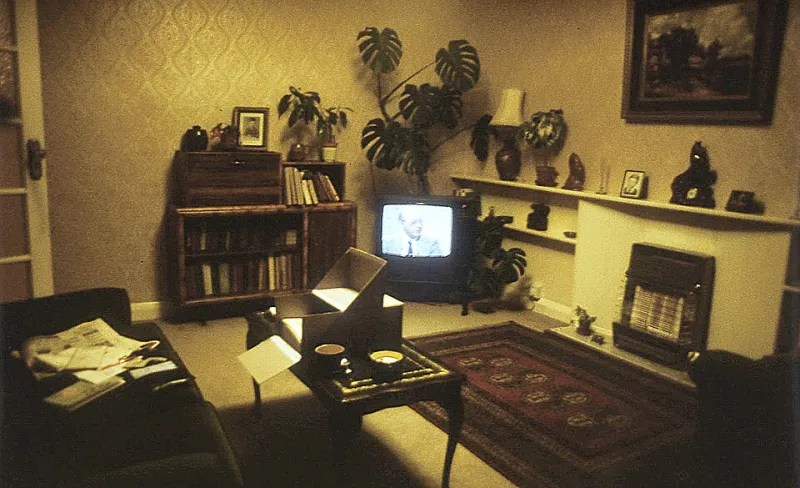
Photo: Gmihail at Serbian Wikipedia, CC BY-SA 3.0 rs, via Wikimedia Commons
There is a particular kind of floor lamp placement that photographs beautifully and fails completely in real life. The lamp is tucked into the corner, the shade is glowing, the room looks calmer. Then you sit down to read, reach for the switch, and realise you have bought a very expensive mood board. The light lands on the wall. The cable crosses the doorway. The shade is at the wrong height, so you spend the evening squinting under a hot little halo.
None of this is about taste. It is about geometry. Before you fall for a lamp's shape or finish, it is worth working out where its light will actually land — and whether you can reach it without getting up again.
Start with the circle, not the corner
A floor lamp does not light a room evenly. It throws a pool of light, usually somewhere between 1.2 metres and 1.8 metres across depending on the shade's shape and the bulb's beam. That pool is the lamp's real territory. Everything outside it is spill.
So the first question is not 'where does the lamp look best?' but 'where do I need the light to land?' Beside a sofa, that usually means over the seat, across a lap, and onto a book or a mug. Beside a reading chair, it means over the shoulder and onto the page, not straight into your eyes.
A useful habit is to sit where you normally sit, then mark a rough arc about 1.5 metres in front of you with masking tape on the floor. That is the outer edge of where a floor lamp can still feel connected to you. Push the lamp further away and the light becomes ambient rather than useful — lovely for atmosphere, hopeless for crosswords.
The reach test: can you switch it without standing up?
This sounds obvious. It is also the most common reason a floor lamp ends up permanently on or permanently off.
Sit in the chair or on the sofa where the lamp will serve you. Now reach, without leaning dangerously, for where the switch would be. If the answer is 'behind the sofa', 'under the shade' or 'across a rug', the lamp is in the wrong place — or the wrong lamp.
Look at the switch type before buying. In-line switches on the cable are fine if the cable runs towards you. Foot switches are excellent beside a reading chair but less so if they sit under a side table. Touch dimmers are handy but can be fiddly for anyone with limited hand strength. For renters, a smart plug can turn a awkwardly placed lamp into a controllable one, but it does not solve the problem of the lamp being two metres from the sofa.
Measure the distance from your seated hand to the proposed switch position. If it is more than an easy arm's length, keep looking.
Shade height is the number most people skip
Floor lamps come in wildly different heights, and the shade's bottom edge matters more than the overall height on the box. For a seated reader, the bottom of the shade should generally sit somewhere between 90cm and 115cm from the floor. Too high and the light glares above your eyeline; too low and it shines straight into your face or clips the arm of the chair.
A simple check: sit down, look straight ahead, and have someone measure from the floor to your eye level. Most adults land around 100cm to 110cm when seated on a normal sofa. The shade's lower edge wants to be at or slightly below that line, so the light falls onto your lap and hands rather than into your pupils.
If you already own the lamp, this is fixable. A shorter shade, a different harp or a simple height adjustment can transform it. If you are buying, take a tape measure to the shop or check the dimensions online properly — 'tall' and 'reading height' are not the same thing.
Cable routes, sockets and the trip line
UK floor lamps usually come with between 1.8 and 2.5 metres of cable. That is not much once you have routed it around a sofa leg and along a skirting board. Measure from the lamp's intended spot to the nearest 13A socket, following the path the cable will actually take — not a straight line through the furniture.
Avoid running cable across a doorway, a hearth or the middle of a walking route. If you must cross a floor, use a proper cable cover or floor trunking rather than hoping nobody notices. Adhesive cable clips are a renter's friend, but they need a clean, dry surface and they will not hold on some textured wallpapers.
Also think about the plug itself. A lamp plugged into an extension lead that snakes under the sofa is a nuisance to switch off at the wall. A lamp with a foot switch is easier to isolate than one with a touch dimmer when the socket is behind a bookcase.
Keep the walking path clear
In a typical UK living room — especially a narrow terrace or a flat with a bay window — the shortest route between the door and the sofa is usually the one everyone uses. A floor lamp placed in that line will be moved, knocked or quietly resented.
Walk the room as you normally would, carrying a cup of tea if you want realism. Note where you turn, where you step around furniture, and where a lamp base would become an obstacle. A lamp needs a clear space around its base of roughly 30cm to 40cm so it does not feel like a hazard. If the room is tight, a slim base and a shade that does not overhang the walkway will earn its keep far better than a wide, statement piece.
A five-minute check before you buy
Before committing, do this in the room where the lamp will live:
- Sit in the chair or on the sofa and measure from the floor to your seated eye level.
- Mark a 1.5-metre arc in front of you with tape — that is the lamp's useful zone.
- Measure from the seat to the nearest socket, following the cable route you would actually use.
- Check the lamp's shade-bottom height against your seated eye level.
- Walk your normal route through the room and note any pinch points.
If the lamp passes those five checks, it will probably work. If it fails two or more, it is a styling object rather than a lighting solution — which is fine, as long as you know which one you are buying.
The best floor lamp is not the one in the prettiest corner. It is the one you can switch on without getting up, that throws light where you need it, and that nobody has to step around on the way to the kitchen. Measure first. The room will thank you.