The North-Facing Sitting Room: Five Floor Lamps for Rooms That Never Get the Sun
Photo: Evelyn Simak, CC BY-SA 2.0, via Wikimedia Commons
Every UK street has them: the house where the sitting room faces the back garden and the good room faces north. The estate agent calls the light 'soft and even'. By 3pm in November it is neither — it's flat, slightly blue, and the sofa looks like it's been left in a car park. The usual response is to add more light, usually from the ceiling, usually in the wrong colour temperature, which makes everything worse.
North light isn't a problem to be corrected. It's just a very particular kind of light that needs a bit of help at floor level.
North light is flat, not gloomy
A north-facing room gets indirect sky light with no direct sun at any point in the day. That's genuinely lovely for a studio or a kitchen with pale worktops — it's consistent, it doesn't glare, it doesn't fade your furniture. In a sitting room in a British winter, though, it leaves you with roughly four usable hours of decent daylight and then a long grey afternoon.
The trap is treating this as a brightness problem. It isn't. It's a warmth and direction problem. You don't need more lumens; you need light that comes from a lower angle, in a warmer tone, in at least two or three places rather than one.
Start with the bulb, because it's the cheapest fix in the room
Before you spend a penny on a new lamp, look at what's in the one you've got.
- Colour temperature: aim for 2700K. Warm white, not 'daylight'. Anything at 4000K or above belongs over a desk or in a garage, and it will make a north-facing room feel like a dentist's waiting area.
- Dim-to-warm: if you can, choose a bulb that shifts down to around 2200K as you dim it. It's the single most effective trick for making a grey room feel like an evening room.
- Lumens: 800lm is plenty for a lamp doing ambient work. A corner glow only needs 500–600lm. More is not better here.
- CRI: look for 90 or above. It matters more than you'd think — paint colours, wool throws and upholstery all go muddy under low-CRI light.
If your lamp has an integrated LED rather than a screw fitting, check the stated Kelvin before buying. A lot of otherwise handsome lamps ship with a 4000K module and there's nothing you can do about it afterwards.
Give the light something to bounce off
An uplighter is only as good as the surface above it. Placed 15–20cm from a pale wall, it turns the wall and ceiling into the light source, which reads as soft and architectural. Placed 60cm out into the room, it just lights the ceiling rose and nothing else.
If your walls are dark — a deep green, a strong grey, a navy — the bounce is weaker and you'll need more of it. A mirror or a large pale canvas opposite the lamp does some of the same work.
Shade direction beats shade style
Three types, three jobs:
- Opaque metal shade: throws a pool of light downwards. Good next to an armchair, useless for a whole room.
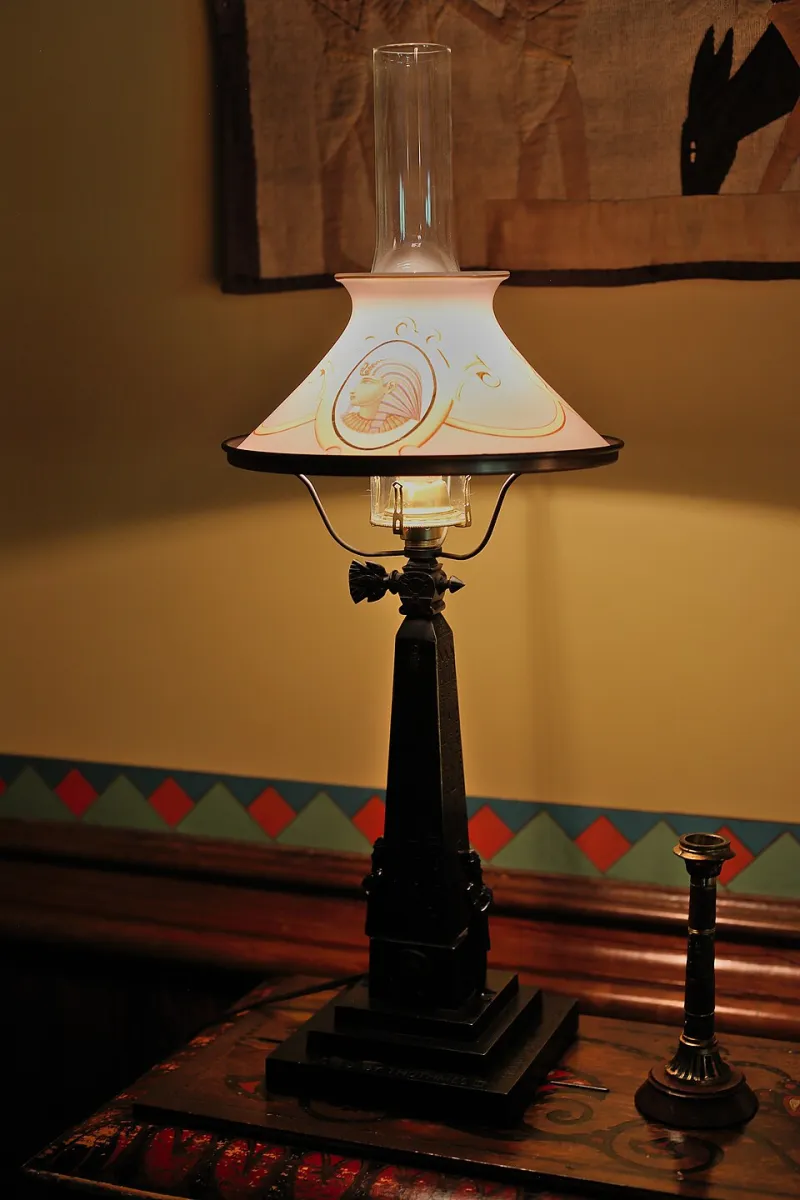
- Opal glass: glows in every direction. Excellent for ambient light and for making a corner feel inhabited.
- Linen or pleated fabric: spills light up and down through the weave, with a soft pool underneath. The most forgiving option in a cool room, because fabric warms the light as it passes through.
A north-facing sitting room wants at least one of the second and one of the third.
The window rule and the mirror rule
Two placement mistakes come up again and again.
First: don't park the floor lamp in front of the window. In a north room, that window is your only free light source and it's already doing you no favours. Blocking a third of it with a shade is self-sabotage.
Second: a mirror on the wall opposite the lamp multiplies the glow. A mirror opposite the window just gives you another rectangle of grey sky. Position mirrors to catch lamp light at seated eye level, not to reflect the view.
Five styles that do the work
1. The tall brass uplighter. A 1.7–1.8m column with a dimmable uplight, tucked into a corner beside the chimney breast. Warm metal, warm light, no shade to date. Look for a weighted base and a proper dimmer rather than a three-step switch.
2. The opal globe on a slim stem. Diffused, low-glare, very good near a mirror or in the corner behind a sofa. Choose 2700K and keep the wattage modest — a glowing orb, not a searchlight.
3. The pleated drum shade on a tapered stem. The most reliable way to make grey walls feel warmer without repainting them. Set the bottom of the shade roughly at shoulder height when you're sitting down, so the light falls on your lap and not in your eyes.
4. The blackened metal dome downlighter. For the reading chair, ideally with an adjustable head. Matte black absorbs light rather than bouncing it about, which keeps the pool controlled.
5. The swept-arm arc with a linen shade. Throws light right across a room from a single socket. Needs a genuinely heavy base — think 7kg and up — and a ceiling height check before you commit. In a low Victorian sitting room, measure twice.
The unglamorous practicalities
Two lamps minimum, three if the room is longer than about 4m. Vary the heights so the light isn't all at the same level. Check your cable reaches the socket without a trailing extension lead across the rug — 2.5m is standard, and a lot of cheaper lamps come with less. And if you're renting, a plug-in dimmer or a smart bulb gets you most of the way without touching the wiring.
Finally, don't chase daylight. A north-facing room lit warmly at 4pm, with two pools of light and a wool throw, feels deliberate. A north-facing room blasted with cool white light just looks like it's trying to be somewhere sunnier.