Plug First, Lamp Second: Planning Floor Lamps Around the Sockets You Actually Have
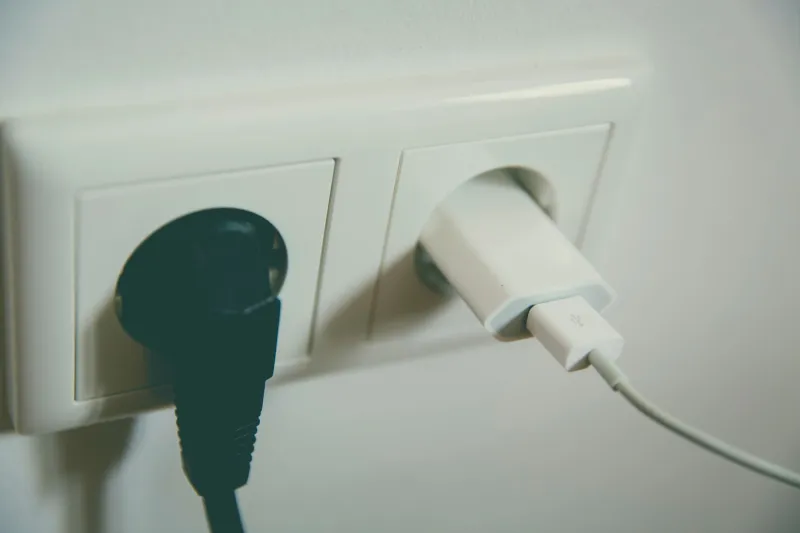
There is a particular kind of disappointment that arrives about twenty minutes into lamp assembly. The shade is on, the bulb is in, you stand back, and then you look for a socket. The only free one is behind the sofa, occupied by a router, two metres from the corner the lamp was bought for. The lamp is fine. The plan was the problem.
Floor lamps are sold as objects and installed as electrical decisions. In a UK living room, the thing that really dictates your lighting layout is not the sofa arrangement in the catalogue or the mood board on your phone. It is a 13A socket at skirting height, put there by a builder who had no idea where your armchair would end up.
The floor plan you can't see
Every room has two layouts. There is the one you drew when you moved in, and there is the one written into the ring main. They rarely agree. A Victorian terrace might have one double socket in the alcove and nothing on the chimney breast. A 1930s semi often has singles in odd places, added one at a time over decades. A new-build might have a generous scattering of sockets in sensible spots and still manage to put the only one near the window behind a radiator pipe.
That invisible plan is the one worth learning before you spend anything. A £600 lamp in the wrong corner is a worse purchase than a £90 lamp in the right one.
The ten-minute socket audit
Do this before you shop, ideally with a phone torch and a bit of patience.
- Walk the room and list every socket. Note whether it is single or double, switched or unswitched, and what is permanently plugged into it.
- Note height. Most are at skirting level, but kitchens and some newer builds put them higher. A floor lamp wants a low socket, or a cable route you are willing to look at.
- Note the obstacles. Door swings, radiator valves, skirting profile, the bit of wall where the carpet gripper bites. A socket is only useful if you can get to it and the plug will sit flat.
- Count the spare ways, not the sockets. A double with two things in it is not a spare socket. It is a full one.
- Photograph the lot. You will forget which corner had the awkward one.
This sounds fussy. It takes less time than choosing a shade, and it will save you from buying a lamp with a 1.8m fabric flex that needs to reach four metres.
Where power tends to live
A few patterns are worth knowing. Sockets are usually grouped near the fireplace wall or on the party wall, because that is where the television and the old standard lamp went in 1978 and nobody has questioned it since. Alcoves often have one, sometimes hidden behind a bookcase. Floor sockets exist, mostly in 1960s and 1970s houses and mostly under a rug by now, and they are a gift if you have one — but check they are sound before you trust them.
If the only socket is on the wrong side of a doorway, that is not a lighting problem. That is a decision about whether you want an extension lead, a different corner, or an electrician.
Extension leads, honestly
Extension leads are not the enemy. Badly used ones are. Four rules cover most of it.
- One lead, used for one job, is fine. A daisy chain of three is not.
- If it is on a reel, unwind it fully before use. Coiled cable under load heats up.
- Never run a lead under a rug, under a carpet, through a doorway, or behind a cushion where it gets crushed. Heat and wear are how leads fail.
- Remember the 13A plug is the limit for the whole bar, not the lamp. An LED floor lamp draws almost nothing. The 2kW heater sharing the same four-way is the actual risk.
A surge-protected bar from a reputable brand is a reasonable long-term fixture behind a sofa. A cheap four-way from a petrol station, with a stiff white cable running across the room, is a temporary measure that will become permanent if you let it.
The smart plug question
If your lamp is in a corner you cannot comfortably reach, a smart plug is the single best £15 you will spend. It gives you a schedule, voice control, and — on some models — energy monitoring, which is genuinely useful when you are trying to work out what is costing you money overnight.
A few practical notes. Smart plugs are bulky; two side by side in a double socket often will not fit. Do not stack them. If you want dimming from a plug, you need a dimmable bulb and a plug rated for it — most are not, so check before buying. And keep the lamp's own switch accessible anyway, because apps break and Wi-Fi drops and you will want a manual override at 11pm.
Cable routes that don't look like an accident
A visible cable is fine. A visible cable that looks like it gave up is not.
- Match the cable to the skirting, not the wall above it. A white flex against white skirting disappears; the same flex against a dark painted wall looks like a mistake.
- Self-adhesive trunking, the D-line sort you can paint over, is cheap and surprisingly tidy. It will not survive a heavy-handed hoover, but it will get you through the year.
- Clip cable along the base of the skirting rather than stapling it. Staples through flex are a classic own goal.
- Leave a small service loop at the plug so the cable is not under tension when the lamp is moved for cleaning.
- Swap the flex if you can. Fabric flex in a colour that matches the wall is a two-minute upgrade and transforms how visible a cable feels.
Renting, and the no-drill version
If you cannot put a screw in the wall, the same logic applies with adhesive rather than fixings. Command-style clips, adhesive trunking, a plug-in smart plug, and a floor cable cover across the one unavoidable walkway will get you a long way. Do not add sockets, do not chase anything into a wall, and do not assume the landlord's wiring is newer than it looks. If a socket is cracked, buzzing, or warm to the touch, report it rather than plugging a lamp into it.
When to call someone
Adding a socket, moving one, or putting a floor socket where there was none is a job for a qualified electrician, not a Saturday afternoon. In England and Wales, some of that work is notifiable under Part P; Scotland and Northern Ireland have their own arrangements. The point is not the paperwork. It is that a floor lamp is a nice object, and the wiring behind it should not be a guess.
The order of operations
Measure the distance from your chosen corner to the nearest usable socket. Then check the flex length on the lamp you are considering — it is often shorter than you think. Then decide whether the answer is a longer flex, an extension lead, a smart plug, or a different corner entirely.
Do that, and the lamp stops being an object you are trying to fit around the room. It becomes part of a plan that already works.