New Hat, Same Lamp: The Under-£80 Shade Swap That Refreshes a Room
Photo: Anthony Vosper , CC BY-SA 2.0, via Wikimedia Commons
There is a particular kind of January-to-March restlessness that makes you want to redecorate the whole house. Resist it. Often, the thing that has gone stale is not the lamp itself but the hat it is wearing. A designer floor lamp base — the heavy brass stem, the sculptural tripod, the slim black reading lamp you bought with actual intention — is usually the expensive bit. The shade is the bit that dates, dulls, or starts to feel like a winter coat you are still wearing in April.
This is the case for the shade swap: one new shade, ideally under £80, and the same base. No rewiring, no moving furniture, no explaining to anyone why there is another lamp in the room. Done well, it reads as a considered refresh rather than a spare shade that happened to fit.
First, the boring bit: fittings
UK floor lamps generally use one of two bulb fittings: E27 (screw) or B22 (bayonet). That tells you which bulb to buy, not which shade. The shade fitting is the part that matters here, and it is usually one of three types.
A spider fitting has a wire frame that sits over a harp or a shade ring and is secured with a finial. It is common on traditional and many designer floor lamps. A euro fitting has an inner ring that drops onto the lamp holder, often with a reducer ring. A clip-on shade clips directly onto a candle or small bulb — less common on floor lamps, but not unheard of.
Before you buy anything, take the old shade off and look at what is actually holding it. Measure the inner diameter of the fitting ring if you can, and check whether your lamp has a harp. Most high-street shades will state the fitting type; if it does not, assume nothing. A £45 linen drum that cannot attach to your base is not a bargain, it is a donation to the back of the cupboard.
Also check the maximum wattage and bulb shape. A shade that is too shallow will show the bulb; too narrow and you will get a hot spot. LED bulbs run cooler, but they still need breathing room.
Proportion is the whole trick
A floor lamp shade should look like it belongs to the base, not like a lampshade that landed on it. As a rough guide, the shade diameter should be about one and a half to two times the widest part of the base. If your base has a wide tripod or a chunky weighted foot, a skinny 25cm shade will look pinched. If your base is a slim brass stem, an enormous 55cm drum will look top-heavy and faintly ridiculous.
Height matters too. The bottom edge of the shade usually wants to sit around seated eye level — roughly 100–110cm from the floor in a living room — or a little above it for a reading lamp. If you are tall, sit in your usual chair and look across at the lamp. You do not want the shade cutting across your line of sight, and you do not want to be staring at the bulb.
For most UK sitting rooms, a 35–45cm shade is the safe middle ground. A 50cm shade can work beautifully on a substantial base in a larger room, but it will swallow a small terrace corner. Measure the old shade before you shop, then decide whether you want the new one to feel lighter and more open or fuller and more grounded.
Fabric versus metal: what the glow actually does
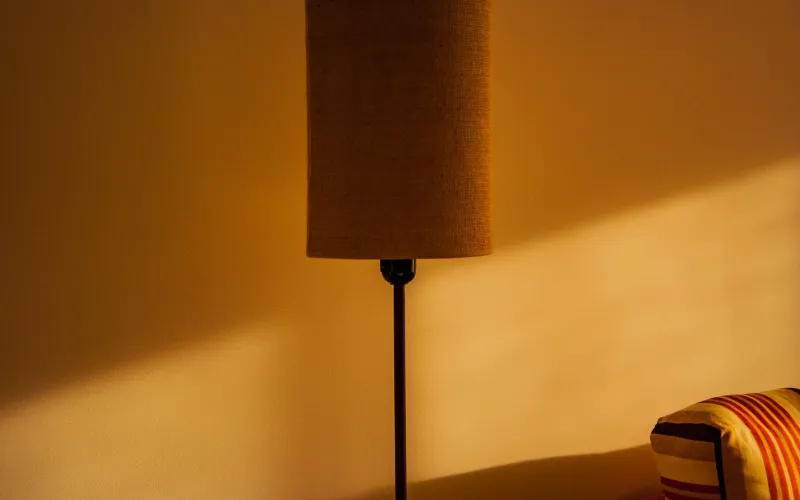
Fabric shades — linen, cotton, a good-quality polycotton — soften light. They diffuse it, spread it around the room and make a floor lamp feel like part of the furniture rather than a spotlight. Oatmeal, off-white, pale grey and soft clay are the colours that tend to look expensive without trying. A linen drum in a warm neutral can make a modest base look far more considered than it did with a dark, heavy shade.
Metal shades do something different. They direct light down or across, creating pools and shadows. Brushed brass, aged steel and matte black can look sharp and architectural, especially on a 1930s or industrial-style base. But metal can also make a corner feel clinical if it is the only light source. In a north-facing room, a metal shade with a warm bulb can be striking; with a cool bulb, it can feel like a waiting room.
Pleated shades are having a moment again, and they are useful if you want texture without pattern. Just be honest about dust. Pleats collect it, and a dusty pleated shade in a sunny bay window is a small tragedy.
Avoiding the 'spare shade' look
The spare-shade look happens when the shade is technically the right size but stylistically orphaned. It is usually too shiny, too patterned, too small, or a colour that matches nothing else in the room. To avoid it:
- Stay within the room's palette. If your room is warm neutrals, a sudden emerald green shade can work, but only if you have another green note somewhere. Otherwise it reads as an afterthought.
- Match the mood of the base. A delicate silk shade on a chunky industrial base will look like a mismatch. A rough linen shade on a fine brass reading lamp can work, but check the scale.
- Upgrade the bulb. A warm 2700K LED will do more for a new shade than any styling trick. Cool white bulbs make even good linen look grey.
- Steam or iron the fabric. Creases in a new shade are the fastest way to make it look cheap. A handheld steamer is your friend.
- Keep the finial. If your lamp has a decorative finial, make sure the new shade's spider fitting works with it. A missing finial makes the whole thing look unfinished.
Three room resets, one small spend
The north-facing Victorian terrace. The base: a slim brass reading lamp. The old shade: a heavy dark velvet drum that made the corner feel like a pub snug in the wrong way. The swap: a 40cm oatmeal linen drum from Dunelm, around £45, with a warm LED. The effect is immediate — the corner lifts, the brass looks brighter, and the room reads as spring rather than permanent December. The dark shade was not wrong in winter; it was just doing too much by March.
The 1930s semi with the brass and black base. The base: a mid-century-style brass floor lamp with a black stem. The old shade: a cream tapered number that had yellowed at the edges. The swap: a brushed brass empire shade from Habitat, under £70, which leans into the base's metallic finish and gives a sharper, more directed pool of light beside the armchair. This is the metal-shade scenario done well: it feels deliberate because the brass repeats, rather than competing.
The rental flat with the black tripod lamp. The base: a cheap-but-cheerful black tripod floor lamp that came with a slightly shiny black shade. The swap: a warm white cotton drum from Argos, around £25, with a 35cm diameter. The black shade made the lamp look like office equipment; the cotton shade makes it look like a lamp someone chose. In a rental, this is the lowest-risk refresh going — no drilling, no rewiring, and you can take the shade with you when you leave.
The £80 rule
You can spend more, obviously. But under £80 is the sweet spot for a shade that looks intentional without tipping into 'I could have bought a new lamp' territory. Dunelm, John Lewis Anyday, Habitat, Argos and B&Q all do credible linen, cotton and metal shades in that range. Charity shops and eBay can turn up older fabric shades with real character, but check the fitting and give them a clean before they go anywhere near your sitting room.
The point is not to buy a new lamp. The point is to notice that the one you already own has been wearing the wrong hat. Swap the shade, warm the bulb, and let the base carry the room again.