The Quiet Focal Point: Giving a Victorian Chimney Breast a Floor-Lamp Second Act

Photo: Victorian chimney breast living room with designer floor lamp UK interior, via as1.ftcdn.net
When a Victorian fireplace stops doing fire, the chimney breast can start to feel like a stage after the play has ended. The mantel is still there and the alcoves still flank it, but the room has lost the thing everyone’s eye used to land on. A designer floor lamp can fill that gap, though not by pretending to be a fire. The better move is to treat the lamp as a piece of architecture: a vertical, glowing element that gives the breast a purpose again without turning the hearth into a lamp museum.
Start with the breast, not the lamp
Before you buy anything, stand in the doorway and look at the chimney breast as a shape. In a typical Victorian terrace it projects somewhere around 30–45cm into the room, with alcoves either side that are often 90–110cm wide. That projection is your friend. It gives a floor lamp something to sit against, frame or gently overlap. It also means you should not simply park the lamp in the nearest empty corner and hope the room pulls itself together. Decide what the breast is doing now: is it a mantel for candles and art, a wall for a mirror, or just a bulky bit of wall that makes furniture placement awkward? The lamp’s job is to answer that question, not ignore it.
Scale: let the lamp meet the mantel
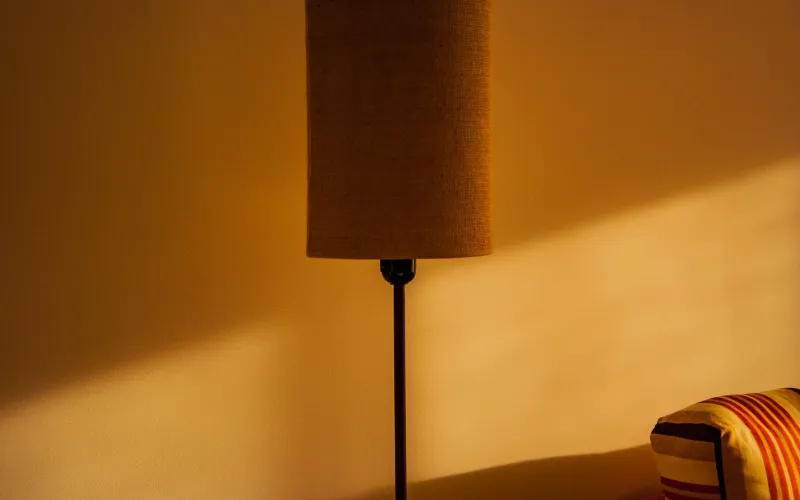
Height matters more than wattage here. If your mantel sits around 110cm from the floor, a lamp that tops out at roughly 140–160cm will feel related to it rather than lost beneath it. A very short lamp in front of a tall breast can look like a stool that has wandered in from the kitchen. Shade size is the other half of the equation. A mean little shade on a tall stem makes the whole thing look like a stick with a hat. For most Victorian sitting rooms, a drum or empire shade in linen, opal glass or a soft pleated fabric, somewhere around 35–45cm across, gives the lamp enough visual weight without shouting. If the room is narrow, keep the base slim and the shade generous; if the ceiling is low, choose a lower overall height and accept that the lamp is there to light a chair, not dominate the architecture.
Place it beside the breast, not inside the fireplace
The most reliable position is just off the edge of the chimney breast, where the breast meets one alcove. From there the lamp can wash light across the wall, graze the mantel and leave the alcove free for a shelf, a small chair or a desk. If you have two alcoves, one lamp is usually enough; two can tip a period room into show-home symmetry. A lamp placed slightly in front of the breast and offset to one side also works well, especially in wider rooms, because it reads as a deliberate layer rather than a sentry standing to attention. What you want to avoid is blocking the alcoves with a lamp that could have gone elsewhere. Alcoves are some of the most useful space in a Victorian home, and a floor lamp should frame them, not fill them. Also resist the urge to stand the lamp inside the fireplace opening. It can look clever in a photograph, but in real life it tends to look like storage and it makes cable routing and ventilation more difficult.
Cable routing and the small matter of safety
A trailing flex across a hearth is the quickest way to undo a good styling job. Route the cable along the skirting board, behind furniture or through a slim floor trunking strip, and use cable clips that can be removed if you rent. If the lamp sits in front of the breast, take the flex to one side rather than straight across the hearth. Avoid running cables under rugs unless you use a proper cable protector, and do not overload extension leads. A switched socket is worth the small effort, especially if the lamp is on every evening.
Then there is the chimney itself. An unused flue still needs ventilation, so do not block air bricks or vents with a lamp, a basket or a stack of books. Keep fabric shades clear of curtains, mantel arrangements and anything that could get hot. A low-heat LED bulb is the sensible choice, ideally around 2700K and dimmable if you want the room to shift from practical to cosy. And check the base. A weighted base on a level floor is non-negotiable in a house with original floorboards, pets or children. A lamp that wobbles when someone walks past will never feel architectural.
Make it look intentional
The difference between a floor lamp that anchors a chimney breast and one that looks left over is usually alignment. Line the top of the shade up with the mantel shelf, or just above it, so the lamp repeats the horizontal line of the breast. Keep the mantel styling simple: a mirror, a couple of candlesticks, one piece of art. The lamp is doing the heavy lifting, so the mantel does not need to compete. Choose a finish that talks to the room rather than matching it exactly: aged brass beside dark wood, black metal against pale plaster, a wooden base where the floorboards are already busy. If the lamp is in front of the breast, angle the shade slightly back toward the wall so the light grazes the plaster and gives the chimney breast some texture.
The second act
A chimney breast without a fire is not a failure. It is a piece of period architecture waiting for a new job. A well-scaled designer floor lamp can give it one: a quiet focal point, a vertical line, a pool of warm light at chair height. Get the scale right, keep the alcoves clear, route the cable properly and let the lamp relate to the mantel. Then the breast stops looking like a missing fireplace and starts looking like the part of the room that was always meant to hold the light.