Lit Sideways: How Floor Lamps Can Make a Narrow Terrace Living Room Feel Wider
There’s a particular shape to a UK terrace living room. You know it: front window at one end, chimney breast somewhere in the middle, a route through to the kitchen at the back, and not quite enough width for the sofa you really wanted. In daylight, it can feel snug and characterful. After dark, with the pendant on, it can suddenly read as a corridor with a telly in it.
The good news is that floor lamps are unusually good at fixing this. Not by flooding the room with more light, but by changing where the light lands. A narrow room doesn’t need to be brighter. It needs to be lit sideways.
Start by switching off the pendant
A single ceiling light flattens a long room. It throws light down the middle, picks out the shortest route from front door to back door, and makes every wall recede. The result is that runway feeling: the eye travels lengthways, and the width of the room almost disappears.
Try an experiment this evening. Turn off the pendant, put one floor lamp in a back corner and another near the sofa, and dim them both. The room will not necessarily look darker. It will look differently shaped. Light at the edges of a room makes the walls feel further away, because your eye reads the glow on the wall rather than the ceiling above it.
Break the runway
The common mistake in a long, thin living room is lining floor lamps up along one wall. It feels tidy, but it reinforces the length of the space. Two matching lamps at the far end can be just as bad: they create a goalpost effect, framing the longest view in the room and making the middle feel tighter.
Instead, think in diagonals. Put one lamp in a rear corner, then place the second on the opposite side of the room, perhaps beside the sofa or chimney breast. You are not trying to be clever. You are simply interrupting the straight line your eye wants to follow. A low lamp here, a taller one there, a pool of warm light on a side wall — these small disruptions make the room feel less like a passage.
Corners are not dead space
In a narrow terrace, corners are valuable. A floor lamp tucked into a corner pushes the boundary of the room outwards visually. The light washes up the two adjoining walls and softens the angle where they meet, so the corner feels less like a hard stop.
You don’t need to light all four. In fact, lighting every corner can make a small room feel staged and crowded. Choose one corner behind a sofa or armchair, and let another part of the room stay quieter. The contrast is what creates depth.
If the corner is tight, look for a lamp with a slim base and a shade that is wider than the stem. A bulky base eats floor space; a generous shade sends light across the walls without needing to sit far out into the room.
Choose shades that throw light sideways
For widening a narrow room, the shade matters as much as the lamp. A narrow beam or a deep, opaque shade directs light down into a puddle, which is useful beside a reading chair but less helpful for making a room feel broader. A wider drum, a shallow tapered shade or a bowl-shaped fitting can push light out towards the walls.
Wall-washing is the quiet trick here. Position a floor lamp with its shade close to a wall — not pressed against it, just near enough that the light grazes the surface — and the wall starts to feel like part of the lighting scheme. In a long room, a softly lit side wall can do more for the sense of width than an extra lamp in the middle of the floor.
Low-slung lamps and the art of the visual detour
Height matters too. A row of tall, slender lamps can make a narrow room feel like a station platform. One tall lamp is fine; three are a rhythm you don’t need. Mix in something lower and wider instead. A low-slung floor lamp with a broad shade anchors the seating area and gives the eye a horizontal line to rest on.
That horizontal line is useful. Long rooms are dominated by verticals — doorways, chimney breasts, window reveals — and by the long view front to back. A low lamp introduces a softer, wider shape at floor level. Put it near a sofa or between two armchairs, and it starts to suggest a zone rather than a route.
Profiles that earn their floor space
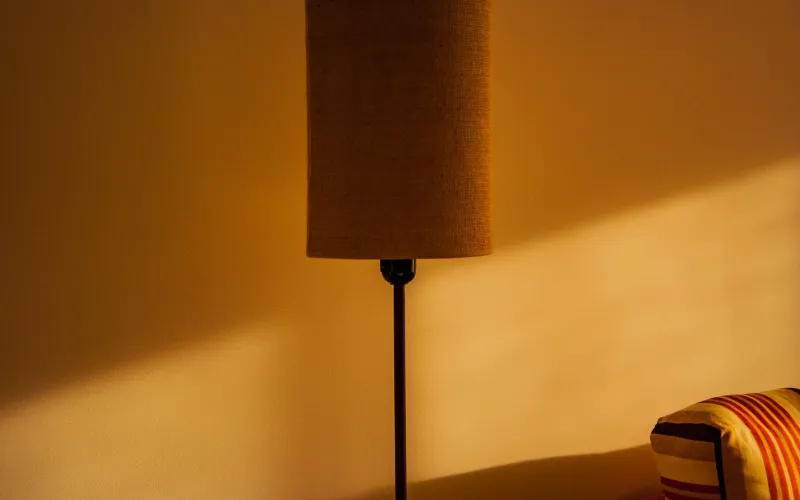
In our edit, the floor lamps that suit narrow terrace rooms tend to share a few qualities. They are visually light at the base, generous at the shade, and easy to dim. A classic tripod lamp with a fabric drum shade is a safe starting point: the legs take up little visual weight and the shade spreads light evenly. A slim column lamp with a wide, shallow shade works well in a corner, especially if the shade is opaque enough to avoid glare at eye level.
A low bowl or up-lighter placed near a wall can be excellent for washing the upper wall and ceiling, though it needs a dimmable bulb and a warm tone to avoid feeling clinical. Small arc lamps can work in a narrow room if the arc is modest; a huge arc reaching across the whole seating area will only emphasise how little width you have. And if the room has a bay window, resist the urge to put the tallest lamp in the bay. A lower lamp there keeps the window feeling open rather than blocked.
Warm light, not murk
A narrow room lit badly can feel like a tunnel. Warm light helps, but too little of it just makes the space gloomy. Aim for a warm white bulb — something in the 2700K region — and use a dimmer or smart bulb so you can take the level down after dinner without losing the shape of the room.
Avoid cool white bulbs in living rooms. They make brick, timber and worn floorboards look grey, and they flatten the softness that floor lamps are supposed to bring. If you have a mix of lamps, keep the colour temperature consistent. A warm pool beside a cool pool looks like a mistake, not a scheme.
A simple arrangement to try tonight
Start with the pendant off. Put one floor lamp in the rear corner, angled so the shade throws light across the side wall. Put a second, lower lamp beside the sofa, closer to the chimney breast than the window. Leave the middle of the room alone. If it feels too dark near the doorway, add a small table lamp rather than a third floor lamp — it keeps the floor clear and stops the room filling up with stems.
The aim is not symmetry. It is a room that feels wider because your eye is given something to look at across the width, not just down the length. In a terrace, that small shift can be the difference between a corridor and a living room.