The Hinge Point: Lighting a Victorian Through-Lounge With One Floor Lamp

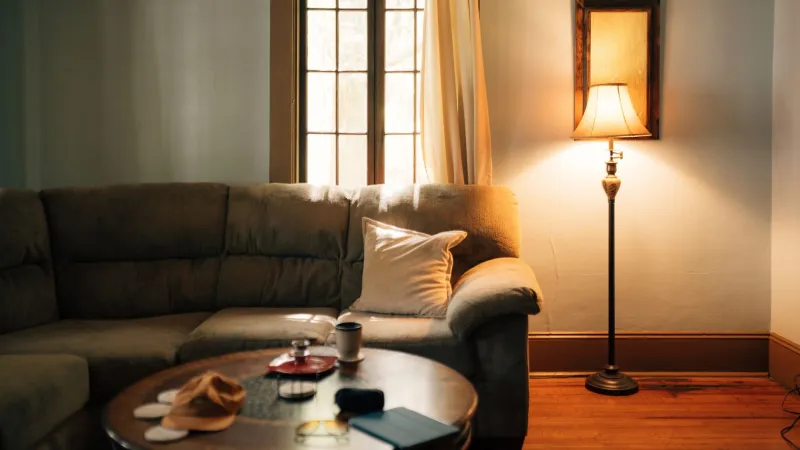
Photo by Photo by Guanghao Zhang on Unsplash on Unsplash
Victorian terraces are full of through-lounges that look generous on paper and awkward in practice. You knock through, or you inherit a double reception with folding doors, and suddenly one long room has to be a cinema, a reading corner, a dining space and a route to the garden. In winter 2026, with the evenings closing in, the floor lamp becomes the piece that decides whether the whole arrangement feels deliberate or like two rooms that have simply been pushed together.
The temptation is to put the lamp in the middle, because the middle is where the room is. In a double reception, the middle is usually the worst place. It lights the walkway, blocks the folding doors and leaves both ends slightly underpowered. A better plan is to treat one designer floor lamp as a hinge: a single, confident source at the point where the front reception becomes the back reception. Not a spotlight for one sofa. A shared anchor.
Start with the two sightlines
Before you buy anything, stand at the front bay window and look towards the back of the house. Then walk to the garden doors and look towards the front. Those are the two views that matter. From each end, the lamp should read as a complete object: shade, stem and base visible, not just a bright bulb floating above a sofa.
This is where scale matters. Victorian rooms have height, but a through-lounge often has a low-lying sofa line and a lot of visual clutter at eye level. A lamp that is too short will disappear behind furniture from one end. A lamp that is too wide will look like a piece of furniture in its own right and fight the cornicing. Aim for a height around 160–175cm in a room with good ceiling height, and a shade that is wide enough to glow but not so wide that it becomes a second table. Check the profile from both doorways at dusk, not just from the sofa you use most.
The hinge is not the centre
In most through-lounges, the natural hinge is the line of the old partition: the folding doors, the arch, the change in ceiling height or the chimney breast that marks the shift from front to back. Place the lamp just off that line, perhaps 30–50cm into the back reception, so it belongs to both zones without sitting in the traffic route.
Do not put it directly in front of the folding doors. You will curse it every time you open them. Do not tuck it behind a sofa where only the top of the shade shows. The lamp needs a little breathing room, ideally against a wall or beside a chimney breast, so the light can wash a surface rather than spill into the middle of the floor. If the room has a wide opening rather than doors, test the position with a broom handle or a masking-tape square for a week. You will quickly learn whether the lamp is a hinge or an obstacle.
Point the light, not the glare
A single lamp serving two zones has to be generous with light and mean with glare. That usually means a diffused shade: linen, opal glass or a lined fabric drum that softens the bulb. Bare bulbs and tight directional shades are handsome in a hallway, but in a through-lounge they can throw a hot spot across a TV screen or into the eyes of anyone sitting at the back.
Keep the bottom of the shade below seated eye level. If you can see the bulb from the sofa, the lamp is too tall, the shade is too shallow, or the lamp is angled towards you. If the lamp has an adjustable head, aim it across the room rather than down onto a face. In the front reception, check that the light does not bounce off a glossy TV or a mirror. In the back reception, check that it gives enough glow to read by without turning the dining table into a stage. Warm white LED bulbs around 2700K are the safe choice; anything cooler will make a Victorian room feel like a waiting room.
Switching and dimming from both ends
One lamp with one switch is only useful if you can reach the switch from both halves of the room. A foot switch near the hinge is ideal, but it must not sit where you will tread on it in the dark. An inline dimmer on the cable is better than nothing, though it can be awkward if the cable disappears behind a sofa.
The practical 2026 answer is often a smart plug or a dimmable smart bulb, paired with a physical remote rather than an app. Guests should not need to download anything to turn on a lamp. Set two scenes: a low evening glow for both ends, and a brighter setting for cleaning or finding the second shoe. If the lamp has its own touch dimmer, check that it remembers the last setting after being switched off at the wall. A lamp that resets to full brightness every time is not a relaxing lamp.
Choose a lamp that reads well from both rooms
The front reception is usually the more formal end: bay window, fireplace, the good sofa. The back reception is often the everyday end: garden doors, a desk, a dining table, the place where shoes come off. You need a lamp that can hold its own in both without looking like it has wandered in from a hotel lobby.
A slim stem, a weighted base and a simple shade in aged brass, dark bronze or matte black will usually sit comfortably in a Victorian terrace. Avoid anything too shiny or too sculptural if the room already has busy cornicing and picture rails. The lamp should feel like a quiet piece of design, not a competition. If you want pattern, put it on the shade in a restrained linen weave rather than on the base. And check the base from both ends: a heavy disc or a tripod that looks elegant from the front can look spindly and mean from the back.
The cable route is part of the design
Cable sprawl is the quickest way to make a designer lamp look like an afterthought. Before you commit to the hinge position, find the nearest socket and plan the route along the skirting, behind furniture or under a rug that nobody walks across. Do not run a flex across a doorway or through a thoroughfare. If you need an extension lead, use a proper surge-protected one, keep it uncoiled and tuck it out of sight. Fabric cable in a matching colour can look intentional, but only if it follows a line rather than looping across the floor.
The dead half-room test
Live with the lamp for a week before you decide it has failed. At night, stand at each end of the through-lounge and look towards the other. If one half still feels like a corridor with furniture in it, the lamp is probably too far into one zone or too directional. Move it 20cm, change the bulb, or add a dimmed wall light if you have one. A single floor lamp cannot light a double reception on its own, but it can give the room a centre of gravity. That is the job: not to flood both rooms, but to make the hinge between them feel intentional. When the lamp reads well from the bay window and from the garden doors, you have found the right spot.