The Friday Night Flip: A Single Floor Lamp for a Spare Room With Two Jobs

Photo: Territorial Army (publisher/sponsor), Unknown (artist), J Weiner Ltd, 71/5 New Oxford Street, London WC1 (printer), Her Majesty's Stationery Office (publisher/sponsor), Public domain, via Wikimedia Commons
One room, two moods, and a lamp that has to cope with both
The spare room is a useful liar. On a weekday morning it is an office: laptop open, mug on a coaster, a stack of post you have not dealt with. By Friday evening it is supposed to be a calm guest bedroom with fresh sheets and a place to put a suitcase. The trouble is that most lighting plans pick a side. A desk lamp says “work here” and stays saying it. A bedside lamp says “sleep here” and is useless for reading a spreadsheet.
A single designer floor lamp can bridge the gap, but only if you choose it for the room’s double shift rather than for one half of it. This is not really about buying the most expensive lamp in the shop. It is about switch access, glare, warmth and the small matter of stopping the thing looking like office equipment once the desk has been folded away.
Start with the switch, not the shade
In a small spare room, the lamp’s switch is the first thing a guest touches in the dark and the last thing you want to fumble for during a video call. Before you fall for a silhouette, work out where the sofa bed’s head end will be and whether you can reach the lamp from it without getting up.
A floor lamp placed beside the bed end is the obvious answer, but the flex has to behave. In a UK box room, the socket is rarely where you want it. A smart plug can turn a standard lamp into something you control from your phone, but it will not help a guest who just wants to read for ten minutes. Look for a switch on the stem, a foot switch on the cable, or a touch dimmer near the top. Anything that requires crawling behind a sofa bed is the wrong design for this room.
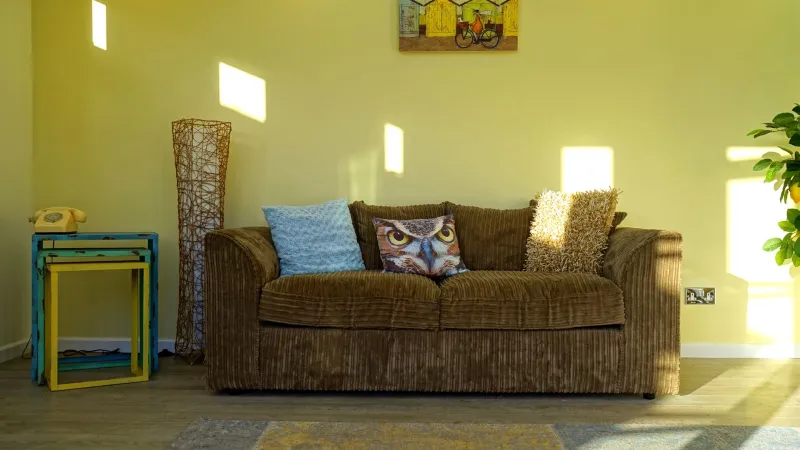
If the sofa bed pulls out across the floor, keep the lamp clear of its travel. A slim base helps, but so does measuring the pull-out before you commit. The lamp should sit in the corner or beside the arm, not in the path between the bed and the door.
Keep the laptop screen out of the light
Desk glare is the quiet reason people end up working with the ceiling light on and the floor lamp off. If the lamp is behind your chair, it throws light onto the screen. If it is directly in front of you, it does the same. The useful position is to the side of the laptop, slightly forward of the screen, with the shade low enough that you cannot see the bulb from your seated eye line.
An opaque shade is your friend here. A linen drum or a pleated cotton shade will soften the light without turning the lamp into a glowing orb. A bare bulb or a clear glass shade may look wonderful in a sitting room, but in a spare room with a laptop it is a glare machine. Warm white bulbs around 2700K are kinder to both faces and screens than cool white, and they make the room feel like a bedroom rather than a branch office.
Evening arrivals want dim, not bright
Guests do not arrive wanting to be interrogated by a 100W equivalent. They want to put a bag down, find the towel and perhaps read a page before sleep. A dimmable floor lamp is the difference between a room that feels welcoming and one that feels like a waiting area.
You do not need to rewire the house for this. A dimmable LED bulb plus an inline dimmer or a smart bulb will do the job. If you already have a smart plug, check whether the bulb is dimmable before you promise anyone mood lighting. The best setup is a lamp you can turn down low for arrivals and up a little for the morning, without moving it.
Stop it looking like office equipment
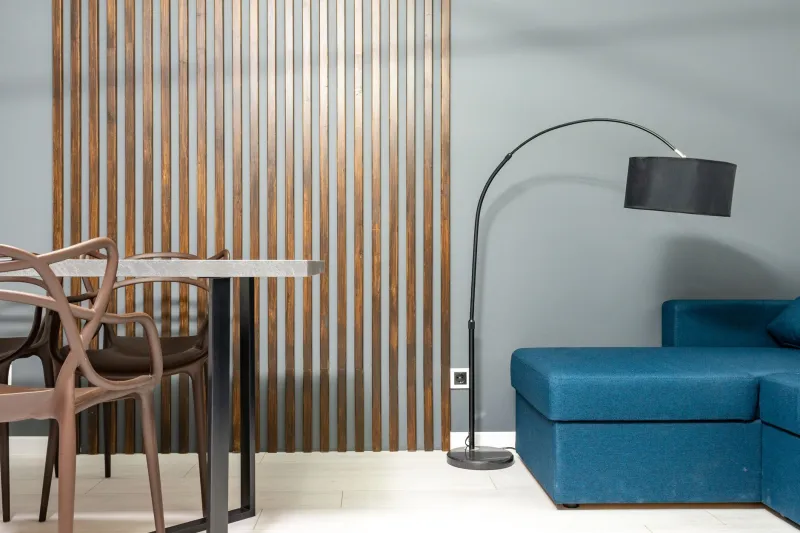
This is where the designer part earns its keep. A floor lamp with a fabric shade, a slim metal stem and a weighted base reads as furniture. A black angular task lamp with exposed joints reads as something from a call centre. In a small spare room, the lamp is on show even when the desk is not, so choose something that looks at home beside a bed: brass, warm metal, ceramic, timber, a soft shade, a quiet profile.
Keep the desk accessories in a drawer or basket so the room can reset quickly. A lamp with a braided flex is easier to live with than a cheap white cable, and a cable tidy or a clip along the skirting will stop the whole setup looking temporary. The Friday night flip should take minutes: fold the desk, straighten the shade, dim the lamp, put out a glass.
What to look for in one sentence
Buy a floor lamp with a stable base, a switch you can reach from the sofa bed, an opaque shade that hides the bulb, and a dimmable warm bulb you can turn down at night. Everything else is taste. In a room with two jobs, the lamp has to be the most adaptable thing in it.